Trail Running Race Intelligence
A pilot project exploring operational intelligence for trail and ultra events. We use GPX routes, checkpoint times, cut-offs and DNF data to help organisers understand race flow, identify pressure points and plan future editions with better evidence.
Client
1,21 GIGAWATTS SL
Category
Sport
Year
2026
Status
Pilot
The challenge
Trail and ultra races are difficult to manage operationally. Runners move across long courses, checkpoints experience uneven arrival waves, cut-offs create pressure at specific points, and DNFs often cluster in ways that are hard to see during the event itself.
Most races already generate useful data through GPX routes, timing systems, split times, finish results and withdrawal records. But that data is often used mainly for rankings, not for operational learning. Organisers may know that a race was hard to manage, but not exactly where the pressure accumulated or what should change before the next edition.
What we are building
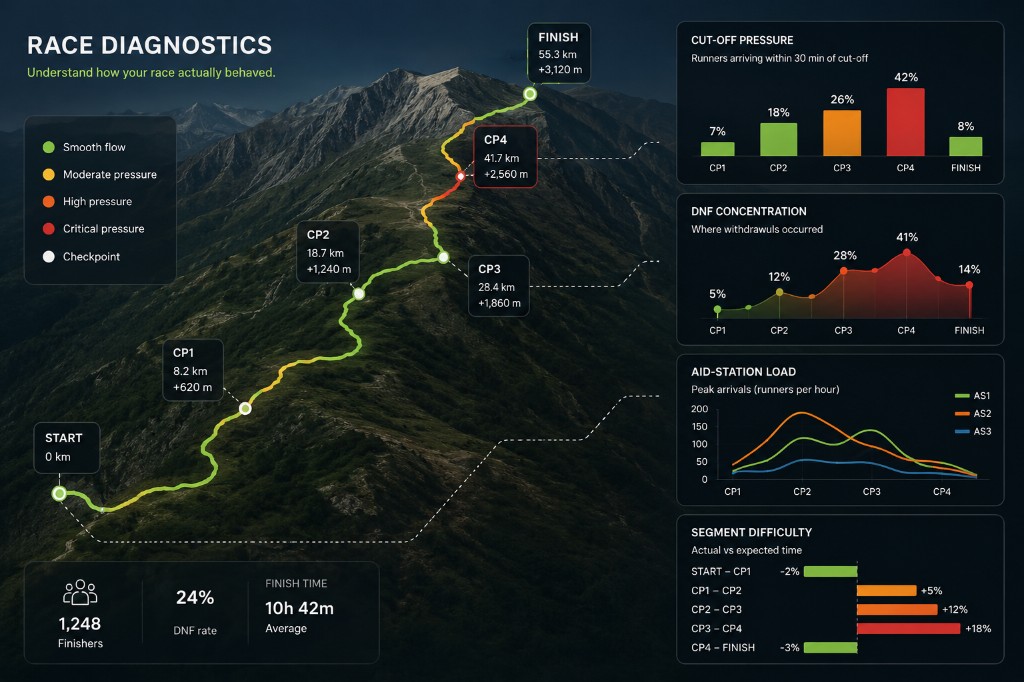
We are building a race diagnostics workflow for trail-running organisers. The first version analyses historical race data to identify patterns in runner flow, segment difficulty, cut-off pressure, DNF concentration and checkpoint or aid-station load.
The workflow is designed to work with simple inputs: a GPX route, checkpoint or split-time results, cut-off times and runner status data such as finisher, DNF, DNS or DSQ. Runner names are not required; bib numbers or anonymised runner IDs are enough for a first analysis.
The longer-term direction is predictive planning: helping organisers estimate checkpoint load, test cut-off changes, simulate participant growth and eventually support live race-control decisions from timing data.
Where this can help
The project is designed to turn race data into a clearer operational picture. Instead of treating results only as rankings, organisers can use them to understand where the field compressed, where runners slowed, which sections created the most pressure, and what may need attention in the next edition.
The objective is not to replace race directors' judgement. It is to give organisers better evidence for planning safer, smoother and more resilient trail events.
We are looking for selected trail and ultra events willing to test this diagnostic approach. A race page, GPX file or split/results link is enough to check whether a first analysis is possible.